
Description
Artificial Intelligence is rapidly becoming part of how organizations work, make decisions, create content, automate processes, and interact with technology. Yet understanding AI requires more than knowing how to use an AI chatbot or write a prompt.
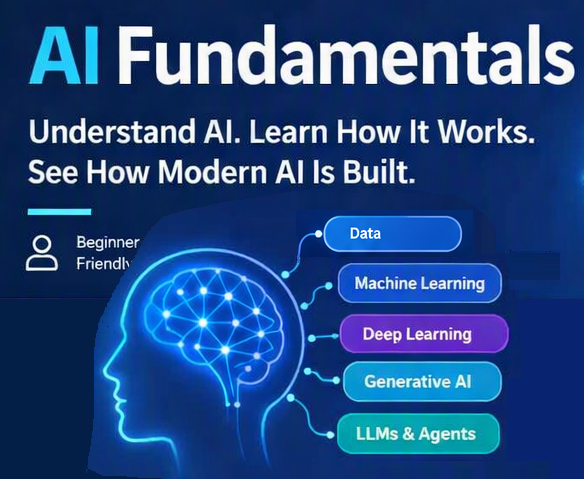
AI Fundamentals provides the conceptual foundation needed to understand what AI is, how machines learn from data, how neural networks work, how modern AI processes images and language, and how today’s Generative AI, Large Language Models, and AI Agents are built.
The course begins with the fundamentals of Artificial Intelligence and establishes a clear relationship between AI, Machine Learning, Deep Learning, Generative AI, Foundation Models, LLMs, and AI Agents.
Learners then explore how Machine Learning systems learn from data, including datasets, features, labels, training, validation, testing, loss, generalization, gradient descent, learning rate, model capacity, underfitting, and overfitting.
The course progresses into Neural Networks and Deep Learning before examining two major areas of AI application: Computer Vision and Natural Language Processing. Learners are introduced to concepts such as convolutional neural networks, embeddings, tokenization, and recurrent neural networks.
The course then moves into the technologies behind modern Generative AI. Learners develop a conceptual understanding of Transformers, attention, tokens, embeddings, foundation models, Large Language Models, pre-training, supervised fine-tuning, human feedback, and prompt engineering.
Finally, the course explores how AI systems can work with external knowledge and perform actions through Retrieval-Augmented Generation (RAG), fine-tuning, AI Agents, tools, workflows, and memory.
Throughout the course, technical concepts are explained from a beginner’s perspective, with emphasis on understanding what each technology does, why it exists, how it relates to other AI technologies, and where it is used.
The course also addresses important limitations and responsible-use considerations, including hallucination, bias, sycophancy, deepfakes, privacy, security, verification, and human oversight.
By the end of the course, learners will have a coherent mental model of modern AI rather than simply a collection of disconnected AI terms.
Who Should Attend?
This course is designed for beginners who want to understand Artificial Intelligence from the ground up.
It is suitable for:
Professionals who want a solid foundation in AI
Business managers and decision-makers
Entrepreneurs and business owners
IT and technology professionals entering AI
Cybersecurity and information-security professionals
Students and recent graduates
Educators and trainers
Professionals preparing for AI-related roles
Anyone who wants to understand how modern AI systems work
Professionals who use Generative AI but want to understand the technology behind it
No Prior AI Experience Required
You do not need:
- Previous AI knowledge
- Machine-learning experience
- Advanced mathematics
- Advanced statistics
- Programming experience
Basic familiarity with computers and digital technologies is helpful but not required.
What You Will Learn
By completing this course, you will develop an understanding of:
AI Foundations
Machine Learning
Data and Model Learning
Machine-Learning Models
Neural Networks and Deep Learning
Computer Vision
Natural Language Processing
Generative AI and LLMs
Modern AI Systems
AI Limitations and Responsible Use


Reviews
There are no reviews yet.