
Resource Center
Reference library
News & Community
- Events
- Terminus Shield
- Newsroom
Media
Tools & Interactives
- Calculators
- Widgets
- Decision Trees
- Games


Human civilization has advanced through successive epochs, each defined by its dominant capability and organizational model:
Era | Defining Capability | Organizational Model |
Agricultural Age | Land | Kingdoms & Hierarchies |
Industrial Age | Machines | Corporations |
Information Age | Computers | Digital Enterprises |
AI Age | Intelligence | Autonomous Organizations |
We now enter the first era in which decision-making itself becomes technological. Every prior organizational model assumed human cognition at its core. Artificial Intelligence disrupts that assumption and with it, the entire architecture of organizational accountability.
This is not merely a technology shift. It is a governance crisis in the making and an opportunity for those who act with clarity and courage.
Organizations worldwide are racing to adopt AI. Algorithms now recommend medical treatments, approve financial transactions, detect security threats, and guide strategic decisions. Yet most organizations ask the wrong question: How do we use AI? The real question is: How do we govern intelligence once it operates inside our organizations?
History offers a consistent lesson: humanity rarely struggles to invent powerful technology. Our enduring challenge is learning to govern it responsibly.
The Industrial Revolution gave us machines before safety standards. The internet connected the world before we understood cyber risk. Today, AI advances faster than our ability to govern it — and the consequences are categorically different from prior technological risks.
Why existing frameworks are insufficient:
No existing discipline addresses the convergence of these challenges at enterprise scale. The result: a governance gap in which organizations deploy AI capabilities without the frameworks to govern them responsibly.
Intelligence without governance becomes risk. Innovation without trust becomes instability.
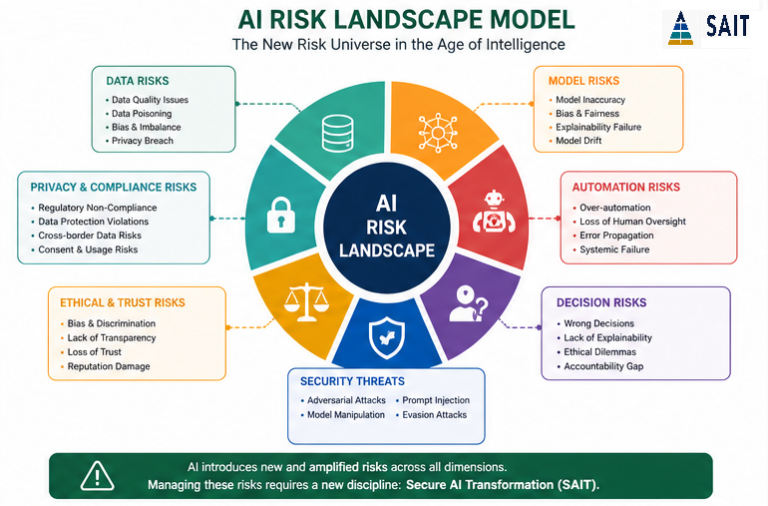
Secure AI Transformation (SAIT) is a new discipline that governs how organizations safely adopt, operate, and trust AI-driven systems while achieving sustainable transformation and value.
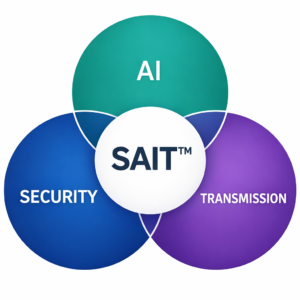
Secure AI Transformation (SAIT) is defined as:
Official Definition Secure AI Transformation™ is the discipline that governs how organizations adopt Artificial Intelligence safely, responsibly, and strategically — while preserving digital trust, operational resilience, and human accountability. |
SAIT integrates five historically separate fields into a unified operating model:
This integration is SAIT’s defining intellectual contribution. The discipline operates at the intersection where no existing field works — governing not systems, not processes, but intelligence itself.
Digital Transformation digitized work. AI Transformation delegates decision-making. Secure AI Transformation governs intelligence itself.
Just as law enabled societal order, accounting enabled economic scale, and management enabled corporations, Secure AI Transformation emerges as the management science of intelligent civilization.
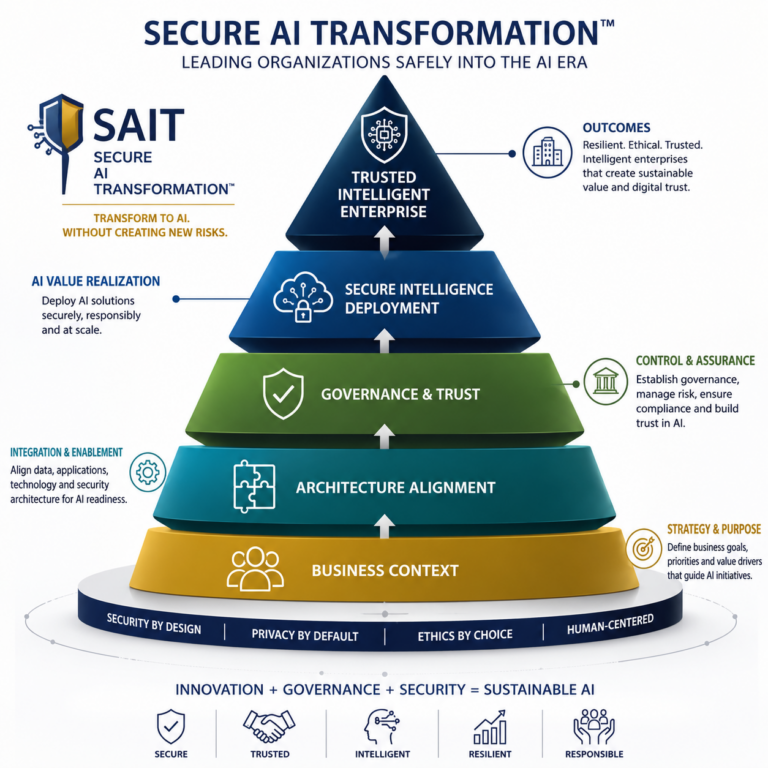
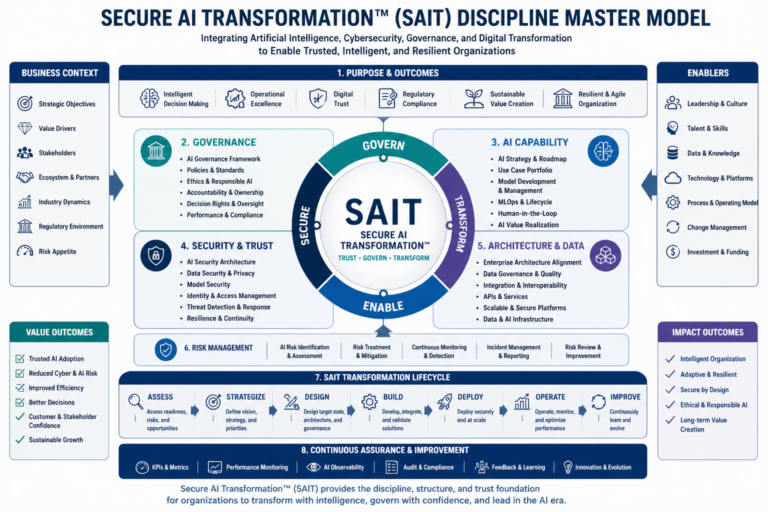
The SAIT Reference Model provides a structured five-layer operating architecture for organizations navigating AI transformation. Each layer is dependent on the one beneath it. Governance cannot be effective without architectural foundations, and architecture cannot be sound without a clear business context.
# | Layer | Focus & Outputs |
01 | Business Context | AI strategy, value priorities, risk appetite — the WHY of transformation |
02 | Architecture Alignment | Enterprise, data, security and AI architecture design — the DESIGN layer |
03 | Governance & Trust | AI policies, accountability models, ethics, compliance — the CONTROL layer |
04 | Secure AI Deployment | Protected ML systems, agentic AI, automation with security controls — the BUILD layer |
05 | Trusted Intelligent Enterprise | Autonomous operations, human-AI collaboration, continuous adaptation — the OUTCOME |
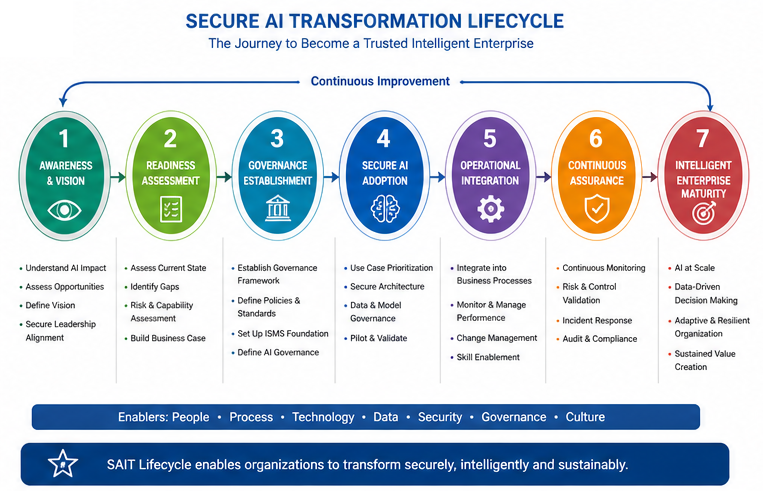
Every organization’s journey to becoming a Trusted Intelligent Enterprise follows a structured lifecycle. SAIT defines seven phases, progressing from initial awareness through full intelligent enterprise maturity with continuous improvement embedded throughout.
The lifecycle is underpinned by seven enablers that must operate in concert: People, Process, Technology, Data, Security, Governance, and Culture. Organizations that treat these as separate workstreams — rather than an integrated system — consistently fail to achieve sustainable AI transformation.
Effective AI governance does not begin at the operational level — it flows from civilization-scale regulatory principles downward through strategic, enterprise, and operational layers. SAIT’s Governance Layers Model provides a structured architecture for this top-down direction and bottom-up assurance:
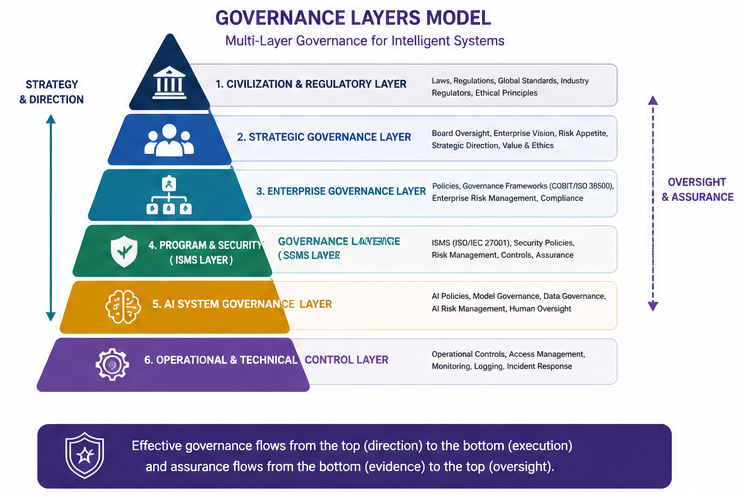
A critical insight of this model: governance direction flows top-down (from civilization-level laws and ethics to operational controls), while assurance flows bottom-up (from operational evidence to board-level oversight). Organizations that invert this relationship — attempting to build governance from the bottom up without strategic direction — produce compliance theater, not genuine accountability.
|
Key Governance Principle Effective governance flows from the top (direction) to the bottom (execution). Assurance flows from the bottom (evidence) to the top (oversight). SAIT governance architecture ensures that both directions function simultaneously. |
Artificial Intelligence is redefining how organizations operate, compete, and make decisions. We are moving from digital enterprises to intelligent enterprises.
Yet most organizations are adopting AI faster than they can govern, secure, or understand it. Innovation without security creates instability. Intelligence without governance creates risk. Transformation without trust cannot succeed.
Secure AI Transformation was founded to close this gap.
It is a global discipline integrating Artificial Intelligence, cybersecurity, governance, and enterprise transformation to ensure organizations evolve safely into the AI era.
The goal is not simply to deploy AI.
The goal is to build trusted intelligent organizations.
The future belongs not to those who adopt AI first —
but to those who adopt it securely, responsibly, and wisely.
Secure AI Transformation governs the Intelligent Age.
Dr. Nader Iranpour
Founder, Secure AI Transformation
Nader Iranpour
Together, let’s build a secure, trusted, and intelligent future.
AI Transformation is no longer optional; it’s essential for organizations seeking resilience, agility, and competitive advantage. Our services provide the guidance, frameworks, and technology expertise needed to align IT with business strategy, optimize processes, and achieve measurable results.
Contact us today to start your Secure AI Transformation journey and empower your organization for the future.